White Paper for the VN-1135
Sep 22nd 2026
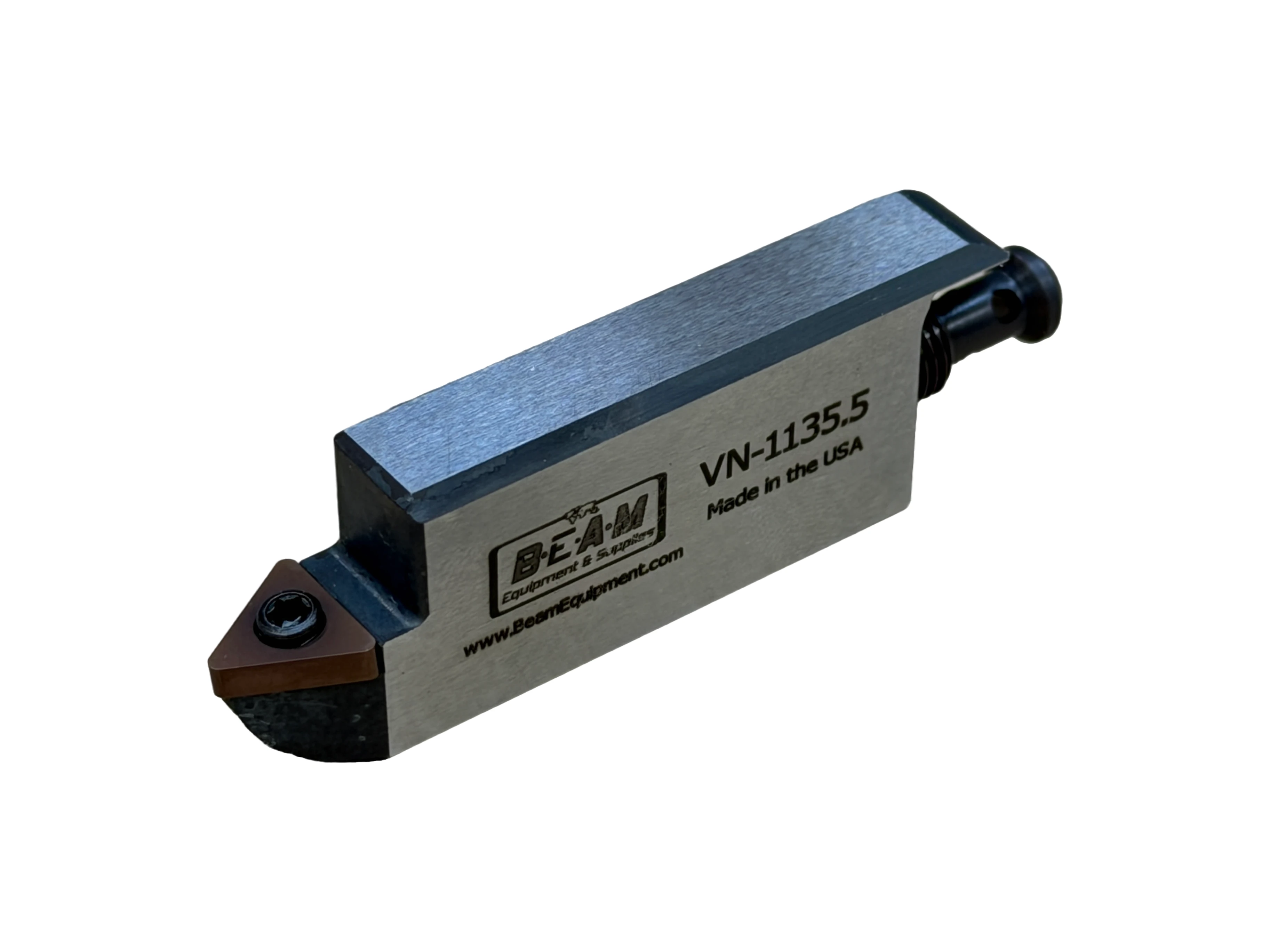
BEAM Equipment & Supplies Part Number VN-1135.5 is a medium-length indexable tool holder designed for Van Norman cylinder boring bars. It delivers the rigidity, dimensional accuracy, and wear resistance required for professional engine rebuilding.
The holder is manufactured from precision-ground hardened tool steel and made in the USA. These attributes produce a more consistent, longer-lasting cutting platform than many competing aftermarket or worn original-equipment holders.
Product Overview
The VN-1135 (SKU VN-1135.5) is an indexable bit holder for cylinder boring. It serves as a long holder on the Van Norman Model 944 and a short holder on Models 777, 900, 905, and 965. It will not fit the S-series machines (944-S and 777-S). It is a direct replacement for the original Van Norman #900-206 tool holder.
Each unit ships ready to use and includes:
- One BE-1120 six-edge indexable cutter insert
- One BE-3MX10 insert screw
- One medium adjusting screw (short and long screws available separately)
Typical list price is $136.95, with most units shipping within 24 hours.
The holder body measures approximately 0.365 in × 0.740 in in cross-section—the critical interface dimension that seats in the non-S Van Norman boring head. This geometry, combined with the hardened steel construction, maintains alignment under cutting loads.
Construction and Materials
BEAM machines the VN-1135 from precision-ground hardened tool steel. Precision grinding produces flat, parallel seating surfaces and accurate pocket geometry for the insert. Hardening increases surface hardness and core toughness so the holder resists deformation, galling, and wear from repeated insert changes and cutting forces.
USA manufacture allows tighter process control over heat treatment, grinding, and final inspection compared with many imported alternatives. The result is a holder that seats consistently in the boring-bar head, holds the insert securely, and transmits cutting forces without chatter or deflection. The six-edge triangular insert design further improves economics: when one edge dulls, the operator simply indexes to a fresh edge rather than resharpening or replacing an entire brazed tool. Replacement inserts (BE-1120) remain inexpensive and readily available from BEAM.
The Adjusting Screw
On the VN-1135.5 uses the original Van Norman specification: 9/32-32 UNF (fine 32 threads per inch) and is made from hardened, non-galling steel. This is not a cosmetic detail. It directly affects setup accuracy, holding power, tool life, and the quality of the finished bore.
Finer pitch = finer, more repeatable adjustment
Each full turn of a 32 TPI screw advances the cutter only 0.03125 inch (1/32"). A coarser 24 TPI or 20 TPI screw moves 0.0417" or 0.050" per turn. When a machinist is setting size with a micrometer or feeler gauge, the finer thread gives smaller, more controllable increments. That makes it easier to hit a target diameter without overshooting and then having to back the screw out and start over. In cylinder boring, even a few thousandths of error can force extra honing time or produce an out-of-spec bore.
Greater mechanical advantage and resistance to loosening
A finer thread has a shallower helix angle. For the same tightening torque it generates higher axial clamping force and is far less likely to vibrate loose under interrupted cuts or the pounding that occurs when the tool exits the bore. Coarser threads used by some competitors have a steeper helix; they can back off more readily, changing the cutter setting mid-pass and producing a tapered or stepped cylinder.
Hardened, non-galling material preserves the thread
The screw and the matching threads in the holder body see repeated adjustments, chips, and cutting-fluid contamination. Soft or untreated steel galls (the threads tear and seize). Once galling starts, the screw no longer turns smoothly, the operator applies extra force, and both the screw and the holder threads are ruined. Hardened non-galling steel keeps the 32 TPI threads clean and free-running so the original precision is retained after hundreds of setups.
Compatibility with original tooling and shop practice
Van Norman boring bars, setting fixtures, and micrometers were designed around the 32 TPI screw. Using the same pitch means existing shop procedures, charts, and fixtures continue to work without conversion factors or guesswork. A coarser aftermarket screw changes the relationship between screw rotation and diameter change, which can introduce systematic error if the operator is not paying close attention. In short, the original fine 32 TPI thread combined with hardened, non-galling steel gives the machinist the same precise, stable, long-lived adjustment that the machine was designed for. Coarser, softer screws trade that precision and durability for easier (and cheaper) manufacturing. For shops that still rely on these vintage but still-capable Van Norman bars, the difference shows up in bore quality and reduced downtime.
The Carbide Insert
The VN-1135.5 is designed around a specific insert: the BE-1120 negative-rake, six-edge triangle. Using that insert—not a “close enough” generic—is part of the tool’s accuracy and life.
Micrograin carbide and TMAX PVD coating
BE-1120 is premium micrograin carbide with a TMAX high-performance PVD coating. That combination is chosen for gray and ductile cast iron cylinder walls, not for general-purpose steel turning.
beamequipment.store
Micrograin (sub-micron) carbide has a finer tungsten-carbide grain and a controlled cobalt binder. Compared with coarser “standard” grades it gives:
- Higher hardness and abrasion resistance against graphite flakes, sand, and scale in cast iron
- Enough toughness to survive interrupted cuts at ports, liner steps, and hard spots
- A keener, more consistent edge that holds size from the first hole to the sixth
TMAX is a high-performance PVD coating applied at relatively low temperature. PVD stays thin and follows a sharp edge instead of rounding it the way thicker CVD coatings often do. In practice that means:
- Better resistance to abrasive wear and built-up edge on iron
- Lower friction and heat at the modest surface speeds of a Van Norman bar
- Longer life per edge so all six corners stay usable
A cheaper uncoated or wrong-grade insert will dull faster, leave a poorer finish, and force more honing. A steel-oriented CVD insert can look “premium” on paper but is often the wrong substrate and coating stack for this job.
Why the holder and insert must be a matched pair
The pocket, clamp screw, and setting geometry of the VN-1135.5 were cut for one insert thickness, one inscribed-circle size, one rake, and one nose radius. Substituting another triangle “that almost fits” changes all of those relationships.
Insert thickness
The pocket depth and the BE-3MX10 screw are sized so the correct insert sits fully on the seat with the cutting edge at the designed height.
- Too thick: the edge sits proud. Diameter setting is then wrong and the insert can chip or crack. You will get a larger bore than the micrometer reads.
- Too thin: the insert has poor support, and can shatter. Edge height drops, so the bore comes out undersize even if the adjusting screw is set “correctly” with the original micrometer.
Wrong tip (nose) radius
The holder and typical cylinder-boring feeds assume a specific small radius. Installing an insert with a larger (or smaller) radius has several direct effects:
- Diameter error. Setting is done to a theoretical cutting point. A larger radius moves the actual contact point back and changes the effective diameter. A few thousandths of radius error shows up as an out-of-spec bore.
- Higher radial force and chatter. A larger radius increases the contact area and the radial component of cutting force. On a relatively slender Van Norman holder that produces vibration, a wavy wall, and premature edge failure.
- Wrong surface finish and feed relationship. Finish is a function of feed and nose radius. A larger radius at the same feed can look smoother but often rubs, work-hardens the iron, and leaves a glazed surface that hones poorly. A smaller-than-designed radius can leave feed marks and a weaker edge.
- Pocket interference or poor seating. The pocket relief is cut for the designed radius. A larger radius may not sit fully in the pocket or may contact the holder body, tilting the insert.
Positive-rake inserts (BE-1119, BE-8101, etc.) used on chamfer and counterbore holders are a different geometry again. They are not interchangeable with BE-1120 in a cylinder-boring holder without changing rake, height, and cutting action.
Practical result
Use the BE-1120 (or the 10-pack BE-1120-10PK) the holder was designed for. That keeps edge height, clamp security, setting procedure, and cutting geometry exactly as intended. Off-brand or “equivalent” triangles that differ in thickness, radius, rake, or grade will produce size scatter, chatter, short insert life, and in the worst case a damaged holder pocket. The modest extra cost of the correct micrograin TMAX insert is recovered in fewer scrapped blocks and less time at the hone.
Quality Advantage Versus Competition
Many competing holders use lower-grade steel, less precise grinding, or imported manufacturing. These differences appear in service as:
- Poor fit in the boring-head slot, causing vibration and poor surface finish
- Faster wear of the insert pocket or adjusting-screw threads
- Reduced rigidity that limits feed rates or produces tapered or out-of-round bores
- Higher long-term cost because of more frequent replacement
A comparable six-edge holder from another major supplier lists at approximately $225—nearly 65 percent more than the BEAM unit—while offering no documented advantage in material or grinding quality.
Customer feedback on the BEAM holder describes it as “a master class of engineering.” Independent users of related BEAM Van Norman tooling have noted that the quality exceeds original factory cutters they previously used.
The combination of hardened, precision-ground U.S. steel, complete insert kit, and competitive pricing gives shops a higher-performance tool at a lower acquisition cost than many alternatives.
Applications and Shop Benefits
Van Norman boring bars remain common in engine-rebuilding shops because of their rigidity and proven geometry. The VN-1135 restores or upgrades the cutting end of these machines so they can produce accurate cylinder bores for automotive, motorcycle, and small-engine work. Benefits realized in daily use include:
- Consistent bore diameter and roundness because of rigid, accurately ground seating
- Improved surface finish that reduces subsequent honing time
- Longer insert life from secure clamping and reduced vibration
- Faster setup—index the insert instead of grinding a new brazed tool
- Compatibility across several popular Van Norman models, reducing inventory needs
Shops that keep both short and long holders (VN-1134/VN-1135 and VN-1136 families) can cover the full range of typical cylinder diameters with a single family of tooling.
Company Context
BEAM Equipment & Supplies LLC has supplied automotive machine shops since 2001. The company operates from Meyersdale, Pennsylvania, and draws on more than 30 years of hands-on industry experience. Its focus is high-quality engine-rebuilding equipment, precision tooling, and hard-to-find repair parts, supported by technical knowledge and fast shipping.
The VN-1135.5 is consistent with that mission: a purpose-built, U.S.-made component that keeps vintage but still-capable Van Norman equipment productive at a professional level. For current pricing, availability, or related holders (long, short, counterbore, and chamfer versions), contact BEAM Equipment & Supplies at beamequipment.com or info@BEAMEquipment.com
*pricing and specifications as of August 2026 and are subject to change.