
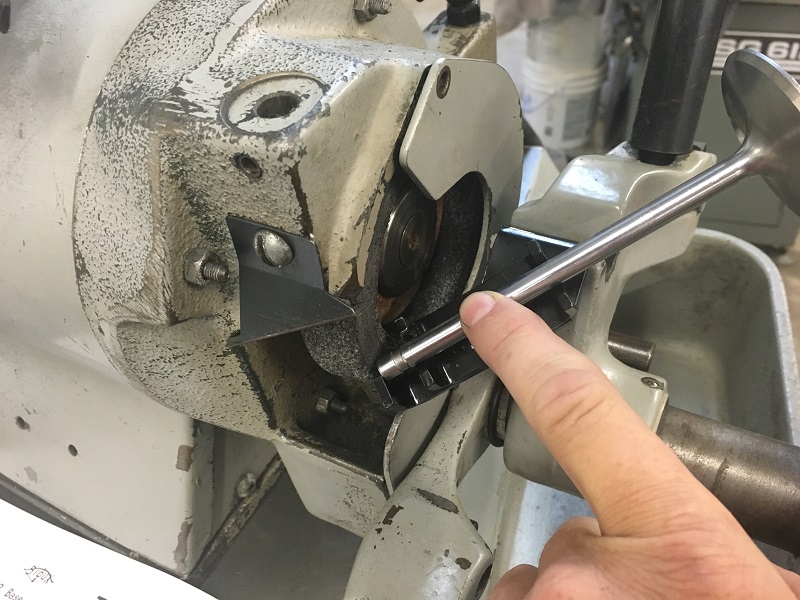
How to Properly Grind a Valve in a Sioux Valve Grinder
Posted by Dennis on Sep 22nd 2026
The Correct Order to Turn a Valve on a Sioux Valve Grinder — and Why the Stem Chamfer Comes Before the Chuck
From BEAM Equipment and Supplies
A Sioux valve grinder will only deliver a true face if the valve is centered correctly in the chuck. That centering does not start when you close the rollers. It starts at the tip of the stem. Skip the stem work, or do it in the wrong order, and the face grind will chase runout that was never in the valve head to begin with.
Sioux machines — including the 680, 2001, 2075, 956/957/958, and related models — locate the valve with a floating aligner that has a tapered, cone-shaped center. That cone does not seat on the flat of the stem. It seats on the chamfer at the stem tip. The rollers then grip the good portion of the stem just above the worn area. If the tip is not square and the chamfer is not clean, concentric, and the right size, the valve will not run true.
That is why the factory sequence is not “chuck it and grind the face.” The stem is prepared first.
The correct order
1. Dress the right-hand (stem) wheel.
The right wheel is used to square the tip and cut the chamfer. Dress it before you touch a valve. A glazed or out-of-true wheel will leave a tipped or uneven end, and that error will be locked into every valve that follows.
2. Square the stem tip.
Place the valve in the stem holder or V-block attachment and grind the tip just enough to clean it up and make it square to the stem. Remove only what is needed — typically a few thousandths. The goal is a flat, 90-degree end with no rocker-arm wear, mushrooming, or pits left on the surface.
Do this first. A chamfer cut on an untrue, worn, or cocked tip will not be concentric with the stem.
3. Renew the stem chamfer.
Mount the chamfering Vee fixture. Hold the squared tip against the stop, feed the stem into the wheel far enough to produce about a 1/32 inch (1 mm) chamfer, and rotate the valve by hand until the chamfer cleans up all the way around. The chamfer must be complete. It does not need to be large.
This is the step that makes the Sioux chuck work.
4. Only then chuck the valve.
Open the chuck sleeve. Insert the valve so the rollers contact the stem just above the worn area. Set the floating aligner so the stem end seats solidly against it. Close the sleeve to the stem, pull the lever, close the sleeve a little more, press the valve into the aligner with a slight rotary motion, and release the lever. Do not run the sleeve down tight and then release the lever — that can lock the chuck.
A rubber chuck shield on the stem is good practice. It keeps grinding oil and grit out of the rollers.
5. Set the face angle and dress the left wheel.
Lock the chuck head at the specified angle (common marks include 29°, 30°, 44°, 45°, and 46°). Dress the left (face) wheel. Set the carriage stop so the valve face uses the wheel without the wheel contacting the stem or undercutting the throat.
6. Grind the face.
Take light cuts. Traverse the valve slowly across the wheel. Do not let the valve pass either edge of the wheel. When the face is clean, back the wheel away from the valve — do not pull the valve off the wheel. Preserve margin. A knife-edge valve is scrap.
If a back-cut or face-break is part of the job, do that after the stem is prepared and the valve is running true in the chuck.
Why the chamfer is not optional
The Sioux roller chuck is fast and accurate when the tip geometry is right. The aligner’s internal taper finds the chamfer and centers the stem on that cone. The rollers then hold the stem without having to fight a cocked or offset tip. Done correctly, runout at the stem can be held to a very small reading. Done incorrectly, shops blame the chuck when the real problem is an untrue or missing chamfer.
That is the first reason to chamfer: concentric location in the machine. The chamfer must be concentric with the stem. Some new replacement valves leave the factory with a chamfer that is not concentric. Experienced operators reface those tips and re-cut the chamfer before the face ever sees the left wheel. One or two valves in a hundred can be out enough to show up in the grind.
The second reason is size and contact. The chamfer should be small — about 1/32 inch — and it must clean up completely. If the chamfer is too generous, the flat of the tip can bottom in the cone instead of the chamfer riding the taper. The valve then locates on the end rather than on the centering surface, and accuracy falls off. Keep the chamfer slight so the cone contacts the chamfer, not the floor of the tip.
The third reason is service life of the part. A sharp, unsquared stem end is a stress raiser. It also makes the valve harder to start into the guide. A light, clean chamfer breaks that edge. Squaring the tip after rocker or actuator wear also restores a proper contact surface so lash and valve operation stay consistent. Sioux’s own reconditioning notes put “true valve stem ends” and “renew chamfer with chamfering vee” at the front of the valve job for exactly that reason: to insure proper valve operation, not only a pretty face.
What goes wrong when the order is reversed
If you chuck a valve with a worn, mushroomed, or un-chamfered tip, the aligner cannot find a consistent center. The face grind then becomes a correction for a location error. You take extra material off the face, lose margin, and still may not get a concentric seat.
If you chamfer before you square the tip, the chamfer follows whatever tilt or wear is already on the end. That chamfer will not be concentric, and the cone will locate the valve off-axis.
If you skip the chamfer on a new valve because “it already has one,” you are trusting a feature that may not be true to the stem. On a Sioux, that feature is the datum.
Factory-trained procedure is blunt on this point: grind the tip first, cut the chamfer next, and only then put the valve in the chuck.
Shop notes that keep the process honest
- Dress wheels often. A few valves can load a stone.
- Use real valve grinding oil. It cools, flushes swarf, and improves finish.
- Chuck on the unworn part of the stem.
- Keep the chuck clean. Grit in the rollers will create runout no chamfer can fix.
- After squaring a set of valves, use the stop so overall lengths stay consistent where the engine requires it.
- If the face still shows runout after a correct stem prep, check the chuck, the aligner cone, and cleanliness before taking more off the valve.
BEAM Equipment and Supplies stocks the pieces this job actually uses: Sioux valve grinder manuals, stem grinding stones, belts, chuck parts, and the Sioux stem chamfering Vee fixture (SX-53589) for 680, 682, 685, 956, 957, 958, 2001, and 2075 machines. The fixture exists for a reason. The machine is built around that small chamfer.
Turn the valve in the right order. Square the tip. Cut a small, complete, concentric chamfer. Then grind the face. That is how a Sioux delivers the accuracy it was designed for.